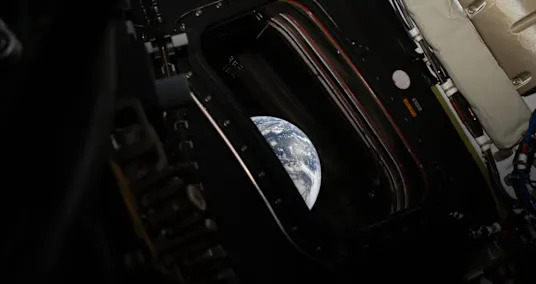
NASA has shared the first breathtaking views of Earth taken from the Artemis II mission as the crew continues its journey toward the moon.
The photos reveal Earth behind the Orion spacecraft, our home planet aglow with aurora.
One photo of Earth, taken Thursday by Artemis II commander Reid Wiseman from the Orion window, shows the planet backlit, with auroras visible at the top right and bottom left, Lakiesha Hawkins, deputy director for NASA’s Artemis program, said Friday during a news conference.

A zodiacal light is also visible at the bottom right as the Earth eclipses the sun, she said.
Another photo of Earth, also taken by Wiseman, shows a terminator line, meaning the line separating daylight and nighttime on the planet.

“What an amazing shot that he shared with us here,” she said.
The photos were taken after completing the translunar injection burn Thursday.
Hawkins said Friday, the third day of the Artemis II mission, that so far systems are normal and “the crew is in great spirit.”

The four crew members — NASA astronauts Wiseman, Christina Koch and Victor Glover and Canadian astronaut Jeremy Hansen — launched Wednesday on the 10-day mission.
As of Friday, the crew is more than 100,000 miles from Earth, with about 150,000 miles to go to the moon.
The mission does not include a lunar landing, but is designed as a step toward a landing in 2028.

The next major milestone for the space pioneers will be Monday, when the crew is expected to fly around the moon.
That flyby could mark the farthest venture from Earth made by humans, surpassing the distance record of 248,655 miles set by the Apollo 13 astronauts in 1970.

This article was originally published on NBCNews.com
LATEST POSTS
- 1
 Meet the Artemis crew in NASA's first astronaut mission to the moon in more than a half-century
- 2Manual for Tracking down the Nearby Business sectors and Marketplaces
- 3Boats escort freed whale away from shallow waters off German coast
- 4How color-changing, bacteria-infused spacesuits could help keep future astronauts safe from space radiation
- 5Cyclone Narelle turns Australian skies blood red in ‘apocalyptic’ scenes


- OECD: Iran war dampening global growth
- Car Investigation: A Survey of \Past the Outside\ Car
- Can humans have babies in space? It may be harder than expected
- In the background: Visiting Notable Film Areas All over the Planet
- Google's proposed data center in orbit will face issues with space debris in an already crowded orbit
- The most exciting exoplanet discoveries of 2025
- 4 Energy-Proficient Clothes washers to Consider in 2024
- Computerized Moderation: Tracking down Equilibrium in the Advanced Age
- Exposure to neighborhood violence leads some Denver teens to use tobacco and alcohol earlier, new study shows