The post Newly Identified ‘Lucy’s Hunter’ Was a 15-Foot Crocodile Lurking in Ancient Ethiopia appeared first on A-Z Animals.
Quick Take
“Lucy’s Hunter” was a massive crocodile that lived alongside early human ancestors in ancient Ethiopia.
The predator likely ambushed animals, including early hominins, at rivers and lakes.
Fossils revealed unique features that identified it as a new species.
The discovery highlights the dangers early humans faced in their environment.
More than three million years ago, in the area that is now Ethiopia, our early human ancestors lived in a landscape that consisted of rivers, wetlands, and scattered woodlands. However, new research has revealed that danger lurked in the water. Australopithecus afarensis, the species best known from the famous fossil known as “Lucy”, shared this habitat with a large ambush predator nicknamed “Lucy’s Hunter”. Keep reading to learn more about this discovery and what it meant for our ancestors.
Who Was Lucy?
The iconic Lucy is perhaps one of the best-known and most remarkable fossil finds in the world. She belongs to the species Australopithecus afarensis, an early branch of our human lineage that lived in East Africa approximately 3.9 to 2.9 million years ago. “Lucy” is the most complete skeleton ever found for such an ancient hominin, consisting of about 40% of the body. She was discovered in 1974 in Hadar, Ethiopia, within the Afar Triangle, which has yielded hundreds of important fossil discoveries. Due to this, Lucy has become vital for helping scientists understand how early human ancestors lived and evolved.

Lucy was an ancient hominin who lived in Africa more than 3 million years ago.
©Procy/Shutterstock.com
Australopithecus afarensis was a small-bodied hominin with relatively short legs, long arms, and a small skull. Australopithecus afarensis showed traits that reflect upright walking and an ability to climb. This hints at a lifestyle that was still at least partially arboreal. However, it also showed that the ability to walk on two legs came before the increased brain size that is typical of modern humans. It’s estimated that female Australopithecus afarensis were approximately 3 ft 5 in, and males were larger at around 4 ft 11 in.
These early hominins lived in and around grasslands, woodlands, rivers, and lakes. Rivers, in particular, were a vital part of their survival as a main water source. However, this would also bring Lucy and her species into close proximity with predators that had adapted to live in the same space. Australopithecus afarensis were not dominant in their environment and were vulnerable to predation by large carnivores.
The Crocodile of Hadar
A recent study has revealed that one of the most formidable predators that our early ancestors would have faced was a massive crocodile, which has been called “Lucy’s Hunter”. The species – Crocodylus lucivenator – was identified from fossilized remains at Hadar. These consisted mainly of fragments of skulls, teeth, and jawbones.
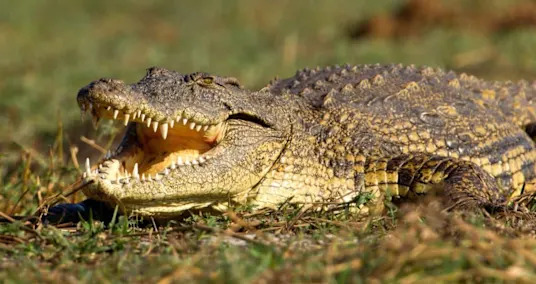
It is estimated that Crocodylus lucivenator was 12 to 15 feet long and weighed between 600 and 1,300 pounds. This is a size comparable to Nile crocodiles. However, it differed from modern-day Nile crocodiles because it had a large, prominent hump on the top of its snout—a feature also found in some other species, such as the American crocodile. Based on the behavior of modern species that possess the same hump, it’s thought that males may have used it to attract females. The species also had a longer, more extended snout. This feature is more similar to those found in modern crocodiles than to those of crocodiles that lived during the same time period.

was a similar size to the modern-day Nile crocodile.
©Gaston Piccinetti/Shutterstock.com
Lucy’s Hunter lived in the rivers and lakes of Hadar, as well as in other suitable wetland habitats. It was a powerful apex predator that likely relied on stealth rather than speed, waiting for unsuspecting prey to approach the water’s edge before attacking. Its large body and strong jaws meant that it would have been powerful enough to seize prey – including Australopithecus afarensis – and drag it into the water. However, fossil evidence also shows that these crocodiles fought among themselves. One specimen had partially healed bite marks on its jaw, suggesting it survived the encounter. These injuries are also consistent with territorial and competitive behavior observed in modern crocodiles.
What This Discovery Tells Us About Early Human Landscapes
The discovery of Crocodylus lucivenator is a particularly important one. This is because it offers a clearer picture of what life may have been like for our early human ancestors. As Crocodylus lucivenator was such a fierce ambush predator, it made accessing water a great risk for Lucy and her species. Rather than being an occasional danger, this threat was likely a constant part of daily life.
This discovery also shows that our ancestors lived in a dynamic landscape with several different environments. The wetland habitats that Crocodylus lucivenator lived in would also have supported a wide range of animals. All of these animals would have been drawn to the same locations to access water. This concentration of prey would have provided reliable hunting opportunities, helping sustain such a large predator.
Although there were several other crocodile species alive at the same time, there is no evidence to suggest that they lived in the Hadar region at the same time as Crocodylus lucivenator. Therefore, researchers think that it was the most dominant predator in the area. However, Crocodylus lucivenator was not the only predator early hominins faced; land-based predators such as lions, hyenas, and leopards also roamed the area. Still, it may have been one of the most dangerous—especially in and around water.
The post Newly Identified ‘Lucy’s Hunter’ Was a 15-Foot Crocodile Lurking in Ancient Ethiopia appeared first on A-Z Animals.



 Russia Establishing Long-Range Drone Bases In Belarus, Warns Ukraine
- Sa'ar warns German delegation: 'A Palestinian state would be a Hamas terror state'
- Whale stranded off Germany for days is stuck again
- Figure out How to Plan for Your Web-based Degree monetarily
- Hyundai Is Keeping the i30 Alive While America Keeps Losing Cars Like It
- Vote In favor of Your Favored Pet Consideration Administration
- NASA shares first photos of Earth taken by Artemis II
- Cocoa Prices Settle Lower on Expectations of Adequate Supplies
- Charli xcx recorded original songs for 'Wuthering Heights' — what to know about the new album for Margot Robbie's film