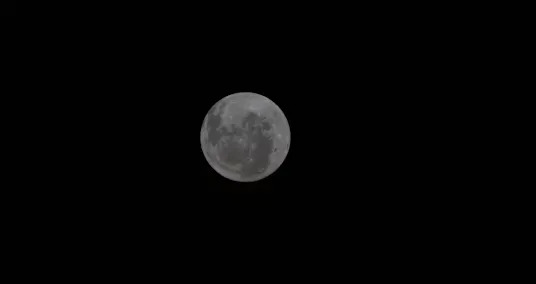
NEW YORK (AP) — The year's first supermoon and meteor shower will sync up in January skies, but the light from one may dim the other.
The Quadrantid meteor shower peaks Friday night into Saturday morning, according to the American Meteor Society. In dark skies during the peak, skygazers typically see around 25 meteors per hour, but this time they'll likely glimpse less than 10 per hour due to light from Saturday's supermoon.
“The biggest enemy of enjoying a meteor shower is the full moon,” said Mike Shanahan, planetarium director at Liberty Science Center in New Jersey.
Meteor showers happen when speedy space rocks collide with Earth’s atmosphere, burning up and leaving fiery tails in their wake — the end of a “shooting star.” A handful of meteors are visible on any given night, but predictable showers appear annually when Earth passes through dense streams of cosmic debris.
Supermoons occur when a full moon is closer to Earth in its orbit. That makes it appear up to 14% bigger and 30% brighter than the faintest moon of the year, according to NASA. That difference can be tough to notice with the naked eye.
Supermoons, like all full moons, are visible in clear skies everywhere that it's night. The Quadrantids, on the other hand, can be seen mainly from the Northern Hemisphere. Both can be glimpsed without any special equipment.
To spot the Quadrantids, venture out in the early evening away from city lights and watch for fireballs before the moon crashes the party, said Jacque Benitez with the Morrison Planetarium at the California Academy of Sciences. Skygazers can also try looking during early dawn hours on Sunday.
Wait for your eyes to get used to the darkness, and don’t look at your phone. The space rocks will look like fast-moving white dots and appear over the whole sky.
Meteor showers are named for the constellation where the fireballs appear to come from. The Quadrantids — space debris from the asteroid 2003 EH1 — are named for a constellation that's no longer recognized.
The next major meteor shower, called the Lyrids, is slotted for April.
Supermoons happen a few times a year and come in groups, taking advantage of the sweet spot in the moon’s elliptical orbit. Saturday night’s event ends a four-month streak that started in October. There won't be another supermoon until the end of 2026.
___
The Associated Press Health and Science Department receives support from the Howard Hughes Medical Institute’s Department of Science Education and the Robert Wood Johnson Foundation. The AP is solely responsible for all content.
LATEST POSTS
- 1
 Hubble Space Telescope spies dusty debris from two cosmic collisions
 - 2Cocoa Prices Sink on Favorable Crop Conditions in West Africa
- 3The 10 Most Significant Virtual Entertainment Missions
- 4Chief of Staff Zamir warns IDF will collapse due to lack of manpower, raises 'ten red flags'
- 5Cuba fights to contain spread of mosquito-borne chikungunya virus





- Argentina reportedly delaying embassy move over Israeli company's oil project near Falklands
- Boeing's troubled capsule won't carry astronauts on next space station flight
- Behind every perfect holiday memory is a mom on the brink
- Artemis II crew take new photo of far side of the moon
- Find the Insider facts of Compelling Systems administration: Building Associations for Progress
- Famous SUVs With Low Energy Utilization In 2024
- The risk of falling space junk hitting airplanes is on the rise, experts warn
- The most effective method to Go Down Abundance through Ages with Disc Rates
- 5 VIPs That Changed Style